Sunday, June 10, 2012

Unforeseen Delay in Posting Chapter 4


Well folks, tonight I INTENDED to post Chapter 4 of Breakout From Bongolaan, my Star Wars Legacy-Era webcomic.  Unfortunately, for reasons I cannot explain, the entire chapter disappeared from my computer. 
I scrupulously use the "Save As" function regularly and my anti-virus software is also up-to-date.  So I'm at a complete and total loss as to why this happened.

To say that I am frustrated and angry over this is a gross understatement.  Nor is this the first time this the first my first brush with file-death.  I had a similar problem on the eve of posting Chapter 3, two months ago.  Back then, when I opened the file, I discovered every photo was deleted.  Fortunately all the narrative and dialogue remained in the picture boxes, which displayed "???" on a khaki backgrounds.  So I opened another page, re-pasted photos, then cut and pasted the verbiage on to the new file.  It was time consuming, but required little re-thinking or re-evaluation of the storyline.

This is far worse, because everything in Chapter 4--all 33 pages of photos, dialogue and narrative--is gone.  When I opened the program, I got a "Unable to Open File" message.  When I conducted file search, I came across a blank file named Chapter 4, but when I tried to open that, I got an "Invalid File" message.  Nor is it in my computer's Recycle Bin.

My original goal was to post one chapter each month, in order to maintain interest among my readers and fans.  I'm already two months behind my goal and I have no idea how long this new delay will cost me.  As of now, I re-created a 33 page framework for Chapter 4 and have a whopping 6 pages of photos re-installed. Once I refill the file with pictures, then I'll have to go through the painstaking task of re-writing the entire scene.

To put my feelings in gamer terms:  My motivation has taken a critical hit.

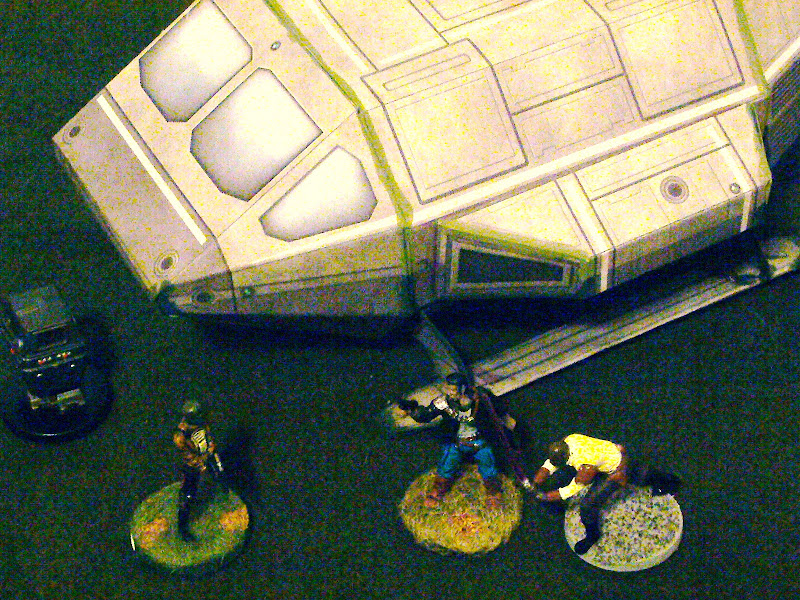
I was really looking forward to posting Chapter 4, because it will be something of a milestone.  This was to be the chapter that introduces the other heroes in the story, seen in the above picture, from left-to-right:  Cad So Billes, Sei'do Avari and Nance Windu. 

I wrote a lengthy e-mail to the folks at Comic Life, the program I use to create my graphic novel. Up until now, I've been very happy with this product. But as I mentioned in my e-mail, if this happens again, I am going to look for another program.

To my readers and fans:  I appreciate your support and patience.  Thank you.

"We are experiencing technical difficulties, please stand by..."

Saturday, June 9, 2012

Enfilade's Bring & Buy Bounty


Next to gaming, Enfilade's "Bring & Buy" is a perennial favorite.  It's essentially a wargamer's flee market.  Any attendee can drop off his unwanted gaming-related material and earn some money--usually to buy other gamers' unwanted gaming-related material.  This can range from finely painted miniatures with a top-dollar asking price, to bargain-basement deals owners want to unload for a quick sell. 

NHMGS takes a 10% cut to add to its coffers, so the Bring & Buy is a win-win-win situation.

As for my personal purchases, I went with the bargain-basement stuff, shown in the lead photo.

I picked up Barbarian Kings for $2.  I'm not sure if I'll get around to playing the game.  Instead, I thought I envision using this as a campaign setting and mechanism for fantasy battles.  That is, if I ever get around to running a fantasy campaign. 

The next bargain I found was Fast Attack Boats, a Yaquinto "album game," for $3.  I bought this for two reasons.  First, I use to own this game.  My brother and I played it a few times, but then I lost it sometime during my miltary suervice.  This wasn't hard to do, because the playing pieces, once cut, are nearly impossible to store in the album sleeve.  (See the review underneath the Forums on Boardgame Geek's [BGG] page).  The second reason I bought this is, I've amassed a scores of Arab-Israeli micro armor and have several related boardgames, so I thought this would make a nice addition to my collection.  (The counters are stored in another Arab-Israeli boardgame). 

The first edition Starfire was another itty-bitty game I use to own, but never played, because my friends at the time were more interested in Starfleet Battles.  I found the boxed version in a pile for $6.  Since I'm now running a Star Wars campaign, I may use this to run large fleet actions.  Yes, I know the counters look nothing like the ships seen in Star Wars movies and games, but Bring & Buy beggars can't be choosers.  Starfire is now on it's fifth edition and has its own website, along with being the source material for five novels.

My last purchase was the most expensive.  For $10 I got Legends of the High Seas.  While I'm not a fan of pirates per se, (especially since we're having enough trouble the Somali variety), I am a big fan of the Age-of-Sail era.  As a result, I own several pirate games, so this Legends will be added to my treasure chest.

I'm very pleased with my purchases and look forward to next year's bounty.

An aside note:  If anyone is interested in downloading and printing the Fast Attack Boats top-down counter sheets and the Record Sheets found under the Files of the BGG entry, I have some words of caution.  When I clicked on the record sheet page goes blank and I get a virus warning message.  While I didn't get a such a message when I attempted to print the top-down counters, various tabs on my computer screen went black and the page failed to print.

Thursday, June 7, 2012

Gamemastering at Enfilade 2012

(Image:  Yours Truly, standing, looking scholarly at my first game at Enfilade 2012)

Well, I managed to survive my Enfilade Gamemastering Triathalon.  As I mentioned in my Product Review post (17 May), this was my first time at running games at a convention.  I've been GMing for close friends since I was a teen, but have never done this with total strangers.

Everyone liked the games I ran, which were Blitzkrieg Commander (BKC), Cold War Commander (CWC) and Future War Commander (FWC)


In my first game, BKC pictured above, there were 3 players who were familiar with the game.  I was greatful for this, since they helped me get with understanding the rules.  However, as the game progressed, this inadvertantly turned into the proverbial double-edged sword, because one or more players often got ahead of themselves in terms of the game sequence.  Fortunately, they recognized what was happening and made efforts to follow the proper order.


My friend Adrian, was a participant in my second game, CWC.  He was running a 3mm CWC game next period and since this was his first time using the rules, as it was mine, he wanted to see how everything played out.  Despite his "alterior motives," I was glad to have a good friend attend one of my convention games.


By the time I ran my FWC game, I was tired but finally comfortable with my GM abilities (or lack thereof).  I chose to use these rules because I have a micro armor collection that spans WWII, through the Cold War and into the sci-fi realm.  I also plan on using FWC for mass combat in my Redshift Campaign.

After reading each set of rules, about 3 times over, I was pleased to see they played-out as I expected.  On the good side, the rules are easy to pick up.  Basically, one needs to roll a 4, 5 or 6 on a 6-sided die to successfully hit an enemy unit.  There are several modifiers and special notes that are often hard to remember, but that's the same issue with any other set of rules.

The command and control mechanism is fairly simple and certainly generates a "fog of war" feeling.  However, I'm not particularly crazy about the idea that since command units are immune to direct fire, they can race ahead of the combat units they're leading.  Since the convention, I wrote a 3-page command variant, which I plan on playtesting with my friends.  Once the bugs are worked out, I plan on incorporating this into the Redshift Chronicles--and maybe using them at the next Enfilade I attend.

Wednesday, June 6, 2012

RIP Ray Bradbury


(Image:  My sister "Rox of Spazhouse" w/Ray Braybury, circa 1998)

The famous sci-fi author, passed away earlier today. 

I must admit I didn't read too many of his books, only Fahrenheit 451 and the Martian Chronicles.  I must say though, my favorite story was The Fog Horn.

Ray Bradbury will certainly be missed.

Remembering D-Day

Monday, May 28, 2012

Remembering Memorial Day


Best wishes to all our veterans, along with my thoughts and prayers for the family members our fallen heroes left behind. 

Thursday, May 17, 2012

Product Review: Specialist Military Publication Rules


For members of the Northwest Historical Miniature Gaming Society, (NHMGS), Memorial Day Weekend is when our flagship convention, Enfilade!, is held.  In the past, we've been able to fill nearly all the tables and host about 120 games during the course of the holiday weekend.  Unfortunately, as of now, we're just shy of 100 games and we're expecting record-breaking attendance.
After the third, or fourth, "call-to-arms" my friends Adrian and Dean issued for gamemasters, I volunteered to run, not one, but three games.  Which by the way, will be my first time I'll be hosting a convention game.  (A future blog post might be on "How Not to Have a Nervous Breakdown at Game Conventions)

I was looking for a set of rules to use for mass combat in my Star Wars Redshift Chronicles campaign and came across the "Commander Series" by Specialist Military Publications (SMP).  I figured if I could learn these rule systems, I could run my own Star Wars game better.

First up, is:


Blitzkrieg Commander, SMP's first product, which is advertised as a "fast play" set of WWII wargame rules.  While the book weighs-in at 120 pages, the core rules only take up 32 pages and that includes illustrated Examples of Play.  The rest of the book is comprised of Army Lists which illustrate unit types, movement rates, attack strength (the number of dice rolled), how much damage a unit can take ("hits"), the availability dates and other asundry of data.

The rules are organized around the game's Sequence of Play, with chapters discussing the Scheduled Phase (for artillery and airstrikes), Initiative Phase (where units can act on their own), Command Phase (where headquarters and commanders issue orders) and the End Phase.  In between the "phase chapters" are sections on Movement, Firing, Artillery and Air Support, along with Close Combat, Engineering and Minefields.

The basic premise of the rules are simple.  A unit type rolls a given number of six-sided dice (1d6s) to attack another unit.  Such attacks are successful on a die roll of 4, 5 or 6.  However, this depends on the terrain the target unit is in.  A target unit can only take a given number of hits, before it is knocked out and removed from the playing table.

Blitzkrieg Commander (BKC) was popular enough that SMP issued the first "spin off:"


Cold War Commander, (CWC), covers the Post-WWII era, from 1946 until today-ish.  The game mechanics are nearly identical, but with some extra added features found in modern combat.  Weapons such as helicopters, anti-tank guided missiles, speicalized (and deadly) artillery and aircraft munitions and differing tactical doctrines employed by the armies of various countries.

Last of all, there's the "final frontier:"


Future War Commander, (FWC), deals with the "what if?" conflicts popularized in science fiction.  Unlike its predecessors, the Army Lists in FWC are based on the current availability of sci-fi miniatures and figures.  So you'll find topics about combat vehicles such as "walkers" and "grav armor," along with devices such as adaptive camouflage, shield domes, plasma and cryonic weapons.

So in preparation for Enfilade, I read each of the rules.  Twice.  While I may not be an expert at these rules, especially since I've only played CWC once at Enfilade 2010, at least my rulebooks are well highlighted.  In fact, the pages are more yellow than white.

After pouring over each book, here's my pre-Enfilade assessment:

Likes:

1. As I mentioned earlier, the rules are simple (4,5, or 6 hits the target).  The Command System is also based on rolling 2 d6s.  A successful dice roll means a commander, or headquarters element can issue an order to a combat formation.

2. But what I like most about these rules are the extensive Army Lists.  Some game companies publish a core rulebook and then if you want detailed information on the various combatants, you have to anxiously wait for--and buy--their supplements.  The all-in-one Army Lists are especially helpful to my work in my Redshift Campaign.

3. Lavishly illustrated Examples of Play.  These sections are a great help in understanding each rule concept.  If you're already familiar with similar rules, then you can skip these parts, which makes reading these rules much faster.

Dislikes:

1. These rules are a "buckets-of-dice" system.  That is, you can combine all the attack dice of every unit firing at a target and roll them altogether.  While I don't particularly hate a system like this, a lot of my gaming buddies do and this makes it hard for me to muster-up any enthusiasm for playing these games. 

2. Armored units get a "saving throw" when attacked.  Which means the defender gets to roll a fist-full of dice to determine whether or not his lead tank "brews up" or not.
3. The rules cover a lot of concepts in a short amount of pages, which means a lot of detail is lacking.  In other words, these are "game" rules and not "simulation" rules.  So a lot of similar units have nearly identical combat capabilities.

Overall:

After my extensive studies, I enjoyed gaining the familiarity with SMP's products and I'm happy I purchased them.

As for my Enfilade preparations:

Due to my work schedule and other commitments, I won't have time to play test these rules before the convention.  How each of my game sessions pan out will be for a later blog post, so stay tuned...

Sunday, April 29, 2012

Space Empires--The Advanced Campaign


A few weeks back, my friends Terry, Tom, Joe and I set out to reconquer the galaxy in GMT's Space Empires.  We tried to randomly draw which empire we'd lead, but Joe & I resumed command of the Altairans and Chulakians we played during our initial session.  Terry & Tom ended up swapping realms, with Terry ruling Terra and Tom the Viscount of Vasyria.


We employed all the advanced rules, which included vessels like fighters and carriers, raiders; along with bases and merchant pipelines (trade routes).  We didn't include the warp points and doomsday machines from the optional rules, but added the indigenous aliens of deep space.

After we explored and exploited our home regions, more or less, we ventured beyond our borders, where the last remnants of the Greyling Empire awaited us.

Despite inhabiting the cold wastes of Deep Space, the Greylings gave our scout ships warm receptions at:

Cygni...
...Babbage...
...Aries...
...Abydos...

...Gath...

...Deneb...

...and Arrakis.

While the Altairans managed to avoid tangling with the Greylings, they had problems of their own.  Altairan scout ships encountered:

Unknown dangers...

...black holes...

...or merely got lost. 

The other empires ran afoul of natural hazards, or experienced catastrophic accidents, to be sure, but after loosing a half-a-dozen scout ships, the Altairan High Command wised-up.  Research and Development efforts were then focused on building cruisers with long-range scanners (in game terms, this is the Exploration Technology).

The other star-faring races didn't catch wind of this development until an Altairan cruiser group uncovered a nebula and mineral deposit just outside their border, without blundering into them.


By the end of the Explore & Exploit Phase of this campaign the galaxy looked pretty much like this: 


The Expand & Exterminate Phase of this campaign, will be resumed at a later date, when our starfleets are strong enough to take on the Greylings--and each other.

Note:  There's still a lot of uncharted areas in Deep Space.  This is because, we decided on an in-house rule, brought up by Terry (I think), that replaces the Danger! and Lost in Space counters with another token until something tangible turns up.

Saturday, April 28, 2012

Book Review: Every Thing I Need to Know I Learned from D&D


"Don't tell mom" is the mantra among my siblings and I.  There are aspects of our lives we'd rather not have our mother know about, so when we confide in each other, we always insert the mantra-phrase at some point in our conversation.

What does my mommy issues have to do with Shelley Mazzanoble's latest book Everything I Need to Know I Learned from Dungeons & Dragons?

Plenty.

You see, Shelly's mom, Judy, continually bombards her darling daughter with well-meaning advice and self-help books.  Said darling daughter, has other ideas on what's best for her.

So the book is a humorous quest for knowledge and enlightenment our hapless author can relate to and more importantly, use.  Topics such as spirituality, travel, fitness, cooperating with others, romance and even child-raising, are related to corresponding game techniques.

There are seven other reviews for Everything I Need to Know, 3 x 5-stars, 3 x 4-stars and one 2-star rating.  The disappointed raters thought the book was more about the game D&D, rather than about associating gaming experiences with real-life and searching for solutions.

I must admit that my own 5-star rating is somewhat biased.  Shelly and I come from the same hometown and we're both now living in the Seattle-Tacoma area.  So it was very entertaining for me to read about familiar sites and places.

If you're a gamer, especially a D&D player, you should be able to relate to some of Life's dilemmas Shelly finds herself in.

Webcomic Chapter 3 Posted


When I started this story, my intent was to post one chapter every month.  Unfortunately, I had some technical difficulties which caused all the pictures to be deleted when exported them from the Comic Life program to computer's C-Drive.  I'm sure this was due to operator error.  In any case, I didn't have time to recreate Chapter 3 before travelling back east to visit my family.

Despite being a month behind, Chapter 3 has now been added to Breakout from Bongolaan, which consists of pages 48 through 77 (54 through 84 using the slideshow) and is also posted on my Redshift Chronicles site.

The Soundtrack Interlude for this chapter is:  I Know There's Something Going On by Frida.  I always thought this song evoked a sense of mysterious foreboding.

One of my friends told me he couldn't find the second chapter.  I realized that clicking on a picture initiates a slide show, so the reader may not see any of the narrative on the blog's page.

In response to this, I created title pages for each chapter.  Here are the titles for the previous chapters:


I used images that weren't already incorporated into the body of the story.  Since only a fraction of the photos I've taken get put into the story, finding a suitable pictures for titles has been easy--so far.